US Treasury Yields Hit Multi-Decade Highs – What Does This Mean for Bitcoin?
by @chaosmagic23 · 2026-09-24
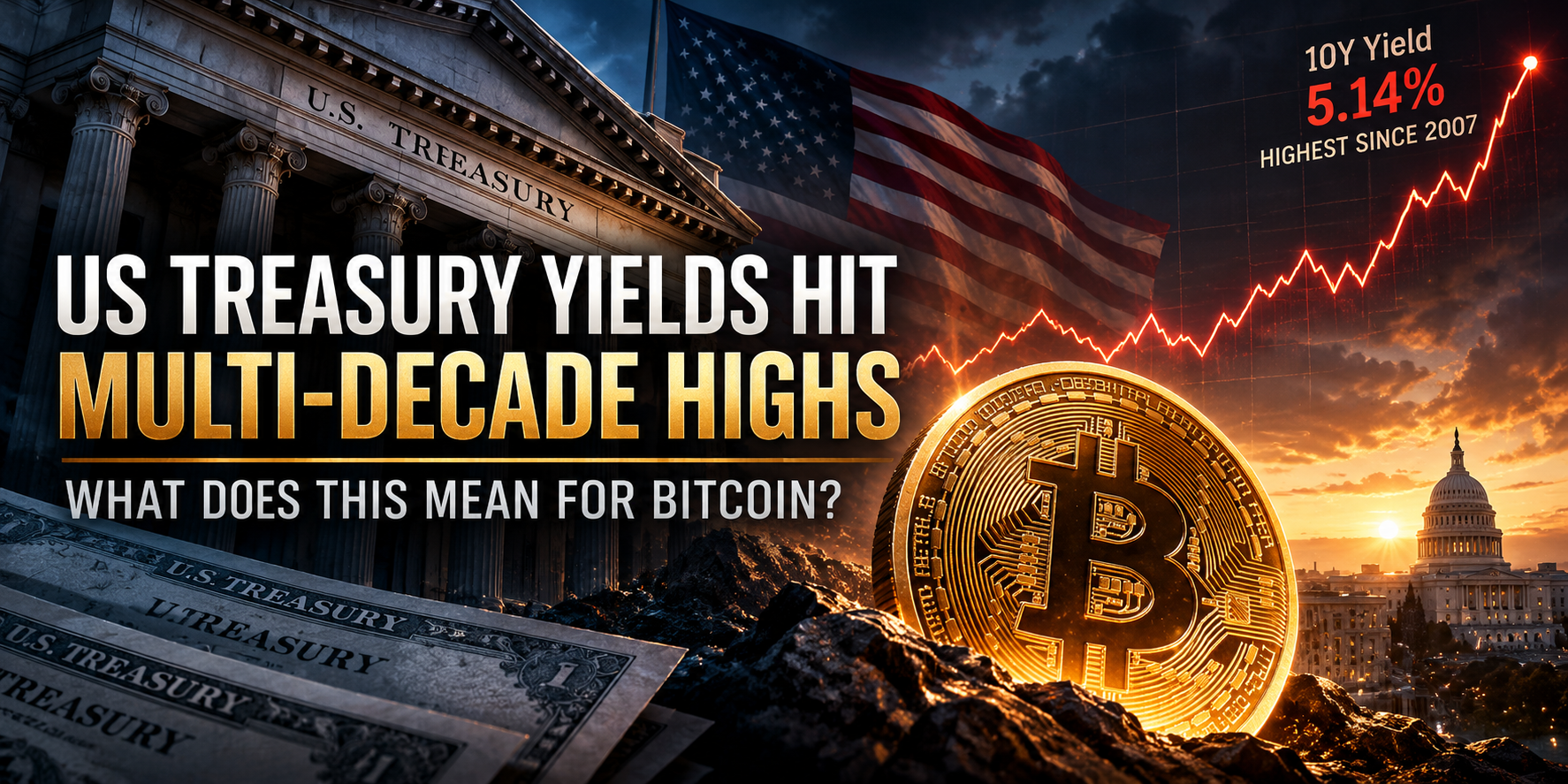
The US bond market is sending a signal that crypto investors should not ignore.
The yield on the **10-year US Treasury has climbed above 5% and recently reached around 5.14%**, its highest level since 2007. The 30-year Treasury yield has moved even higher, reaching levels not seen in more than two decades.
For Bitcoin investors, this matters.
A lot.
## Why Are High Treasury Yields a Problem for Bitcoin?
When US government bonds offer more than **5% per year**, investors suddenly have a very attractive alternative to risk assets.
Think about the choice facing a large institutional investor:
A US Treasury can generate around 5% annually with comparatively low credit risk.
Bitcoin, on the other hand, generates no native yield simply by holding it and comes with significantly higher price volatility.
That doesn't make Bitcoin a bad investment. But it changes the opportunity cost of holding BTC.
When risk-free or low-risk yields rise, capital tends to become more expensive and investors have less incentive to chase returns in assets such as:
* Bitcoin and cryptocurrencies
* Technology stocks
* Growth stocks
* Real estate
* Other speculative assets
This is one reason rising bond yields can create substantial pressure on Bitcoin.
## Real Yields May Be Even More Important
The nominal Treasury yield isn't the whole story.
US **real yields – yields adjusted for expected inflation – are also extremely high**, with the 10-year real yield recently approaching roughly 3%.
That is significant.
An investor can currently earn a substantial positive return above expected inflation from US government debt.
Bitcoin therefore has to compete not only with a Treasury yielding around 5%, but with an asset providing a historically attractive **real return**.
For risk assets, that is a serious headwind.
## The Levels I'm Watching
For the 10-year Treasury yield, I currently see several interesting zones.
**Below 4.8% – relatively positive for Bitcoin**
Financial conditions would begin to loosen and the pressure from bonds would decrease.
**4.8%–5.0% – moderate headwind**
Still uncomfortable for risk assets, but manageable.
**5.0%–5.25% – significant pressure**
This is approximately where we are now. Treasuries become extremely competitive with other investments.
**5.25%–5.5% – danger zone**
At these levels I would expect increasing pressure not only on Bitcoin, but also on technology stocks, real estate and highly leveraged companies.
**Above 5.5% – something may eventually break**
At that point, the question becomes bigger than Bitcoin.
High borrowing costs begin affecting governments, corporations, mortgages, commercial real estate and the financial system itself.
And this is where things become particularly interesting for Bitcoin.
## The Bitcoin Paradox
Rising Treasury yields are initially bearish for Bitcoin.
But there is another side to this story.
The United States is carrying an enormous and growing debt burden. Higher interest rates mean refinancing that debt becomes increasingly expensive.
If investors begin demanding higher yields because they are worried about:
* persistent inflation
* massive government deficits
* rapidly growing US debt
* increasing Treasury issuance
* long-term currency debasement
then rising yields could eventually strengthen one of Bitcoin's fundamental narratives.
Bitcoin has a fixed maximum supply of **21 million BTC**.
Governments cannot create additional Bitcoin to finance deficits.
Central banks cannot change Bitcoin's monetary policy when debt servicing becomes uncomfortable.
The rules are enforced by the network.
That distinction becomes increasingly important when confidence in traditional sovereign debt and fiat monetary systems is questioned.
## Short-Term Pain, Long-Term Signal?
This creates an unusual situation.
In the short term:
**Higher Treasury yields = bad for Bitcoin.**
Capital becomes more expensive, liquidity tightens and investors can earn attractive returns without taking Bitcoin's volatility.
But in the longer term:
**Extremely high Treasury yields may expose structural weaknesses in the debt-based financial system.**
And if yields eventually become so high that something breaks, governments and central banks may once again be forced to provide liquidity.
Historically, Bitcoin has tended to perform much better in environments where global liquidity expands.
So I'm watching the US 10-year Treasury almost as closely as I'm watching the Bitcoin chart.
For me, **5.25% is an important warning level.**
Around **5.5%**, things could become considerably more interesting.
Not only for Bitcoin.
For the entire financial system.
And perhaps that is the great irony:
The same bond-market stress that hurts Bitcoin today could eventually remind investors why a decentralized, scarce monetary asset like Bitcoin exists in the first place.
---
**What do you think?**
Are Treasury yields above 5% a serious threat to Bitcoin – or could the growing pressure in the US bond market eventually become another argument *for* Bitcoin?
There is no order without chaos.
<center>

[](https://witness.the-hive-mobile.app/#/witnesses/@thebbhproject)
<sup>[Vote for the BBH Witness](https://witness.the-hive-mobile.app/#/witnesses/@thebbhproject)</sup> <br>

<sup>chaosmagic23@sats.v4v.app</sup><br>
</center>
*Images and screenshots are from me or AI generated*
<sub>Posted via [HiveSuite](https://hivesuite.app/@chaosmagic23/us-treasury-yields-hit-multi-decade-highs-what-d-hyd8i7u0)</sub>